August 26, 2025
Why You Shouldn’t Judge a Mutual Fund by Its NAV
Thinking low NAV means a better mutual fund? Think again. Learn why NAV is irrelevant and what truly matters for your investments.
Read more

India's economy continues to show resilience. The Reserve Bank of India (RBI) has actually raised its FY27 GDP growth forecast to 7.1%. Yet Indian equities have been under pressure, foreign investors are selling, the rupee is close to record lows, and crude oil has crossed $100 a barrel.
So, what is going on?
The answer lies in an important distinction: a strong economy does not automatically mean a stock market is attractive.
Stock prices respond not just to economic growth, but also to inflation, interest rates, global bond yields, currency movements, foreign capital flows, valuations and, most importantly, future corporate earnings.
For investors, the real question is therefore not “Will the market fall further?” but:
Is the current decline creating an investment opportunity, or are earnings and valuations likely to deteriorate further?
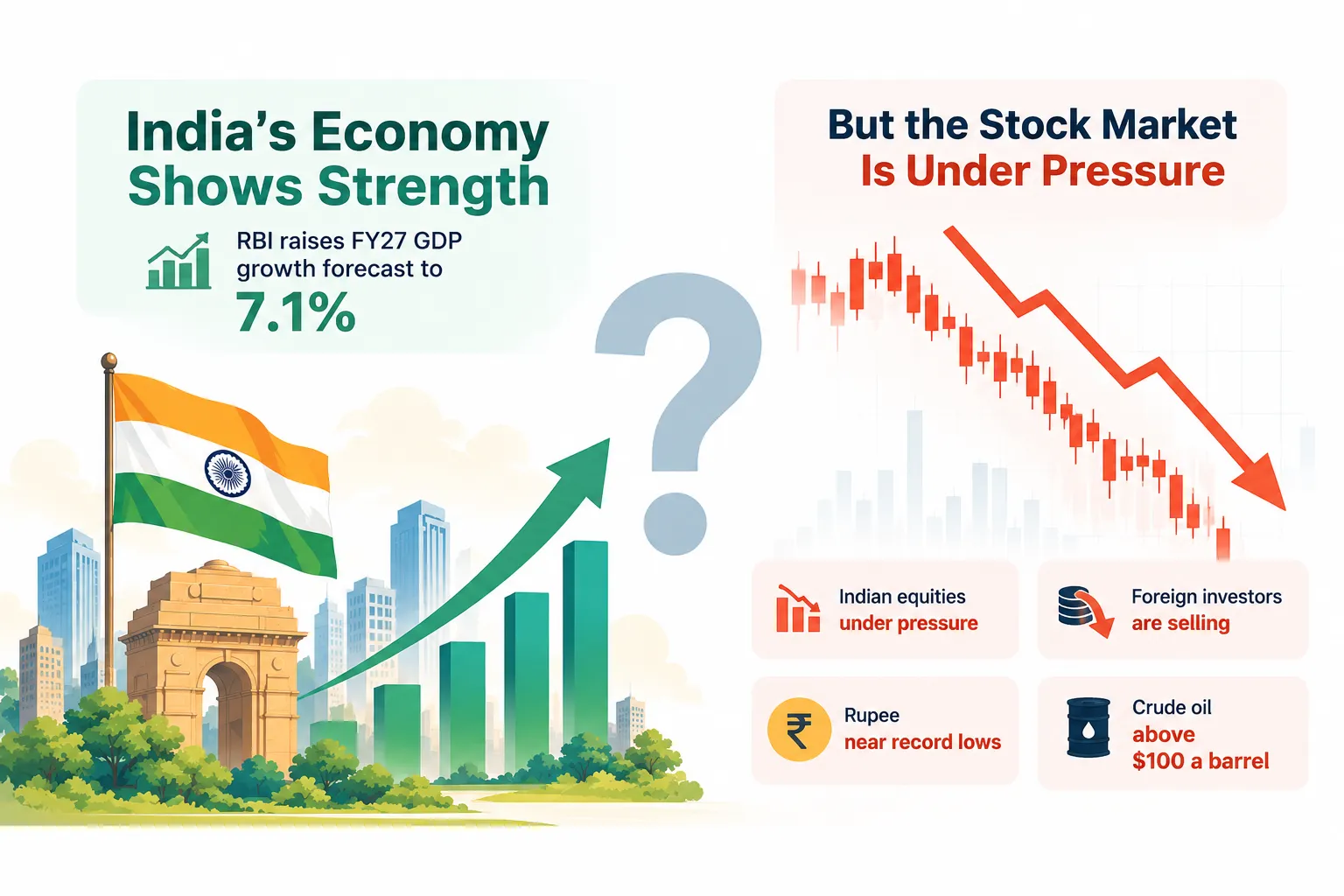
The RBI has raised the repo rate by 25 basis points to 5.50%, its first rate hike since February 2023, and shifted its policy stance from neutral to “calibrated tightening.” At the same time, it raised its FY27 GDP growth forecast to 7.1% but increased its inflation forecast to 5.2%.
The RBI is essentially saying: the economy is strong, but inflation is becoming a problem again.
Higher interest rates make borrowing more expensive. This can eventually affect housing, consumption and corporate investment. More importantly for the stock market, higher interest rates can reduce the valuation investors are willing to pay for future corporate earnings.
Don't interpret a rate hike as automatically bearish for equities. The important question is how long rates remain high and whether higher rates eventually hurt corporate earnings.
If growth remains strong while inflation stabilises, the impact may be manageable. If inflation remains elevated and more rate hikes follow, the pressure on valuations could increase.
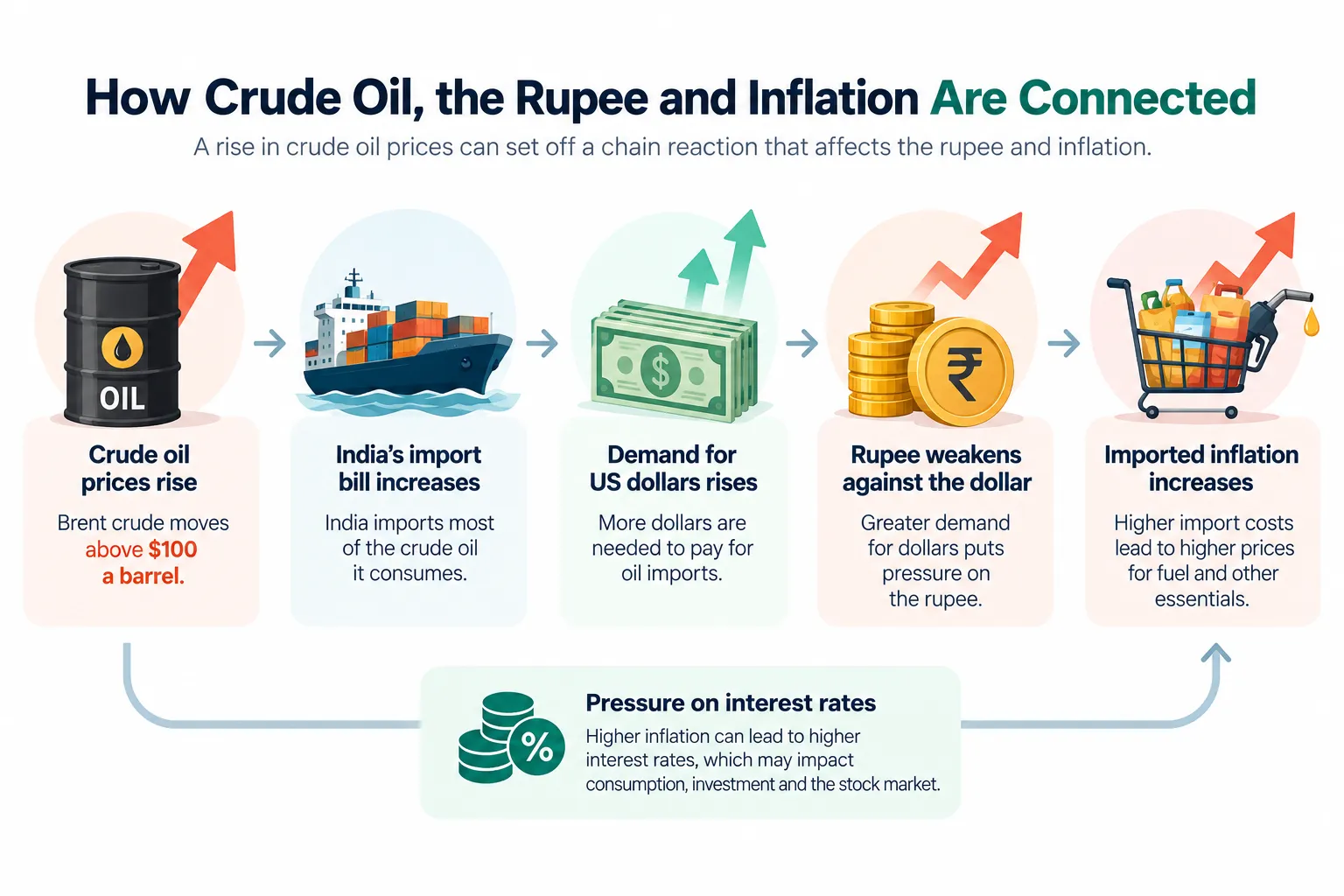
Brent crude has moved above $100 a barrel, while the rupee has weakened towards ₹97 against the US dollar. India's foreign exchange reserves have also fallen by roughly $50 billion from their September peak as the RBI has intervened to manage currency volatility.
India imports most of the crude oil it consumes.
When oil becomes more expensive, India needs more dollars to pay for those imports.
That creates a chain reaction:
Higher crude → higher import bill → greater dollar demand → weaker rupee → imported inflation → pressure on interest rates.
The impact is different for different companies.
Oil-importing businesses can face higher costs, while companies with strong pricing power may be able to pass some of those costs to customers. A weaker rupee can also benefit exporters such as some IT and pharmaceutical companies.
Therefore, investors should not treat a weak rupee or expensive crude as a uniform negative for the entire market.
US Treasury yields have risen sharply, with the US 10-year yield recently moving above 5.3%. At the same time, crude prices have risen and the rupee has weakened. FPIs sold more than ₹25,000 crore of Indian equities in September, while selling accelerated in the second half of the month.
An overseas investor comparing India with the US is not looking only at Indian company profits.
If US government bonds offer attractive yields with considerably lower perceived risk, the investor may decide that the additional risk of emerging-market equities is no longer worth taking.
FPI selling can push markets down in the short term, but it does not necessarily mean Indian companies have suddenly become fundamentally weaker.
Foreign flows tell us about global liquidity and investor preferences. Corporate earnings tell us about the health of businesses.
The two should not be confused.
This is where the current correction becomes interesting.
The Nifty 50's forward P/E has fallen substantially from its 2024 levels. One recent analysis puts it at around 17.4 times forward earnings, compared with 21.5 times in 2024, bringing valuations closer to post-Covid lows.
Another recent analysis found that the Nifty 50 was trading around 18% below its long-period valuation average, while small-cap valuations remained significantly more elevated.
Imagine a company earning ₹100.
If investors were previously willing to pay ₹2,100 for those earnings but are now willing to pay ₹1,740, the stock has become cheaper assuming the company continues to earn ₹100.
That last part is critical.
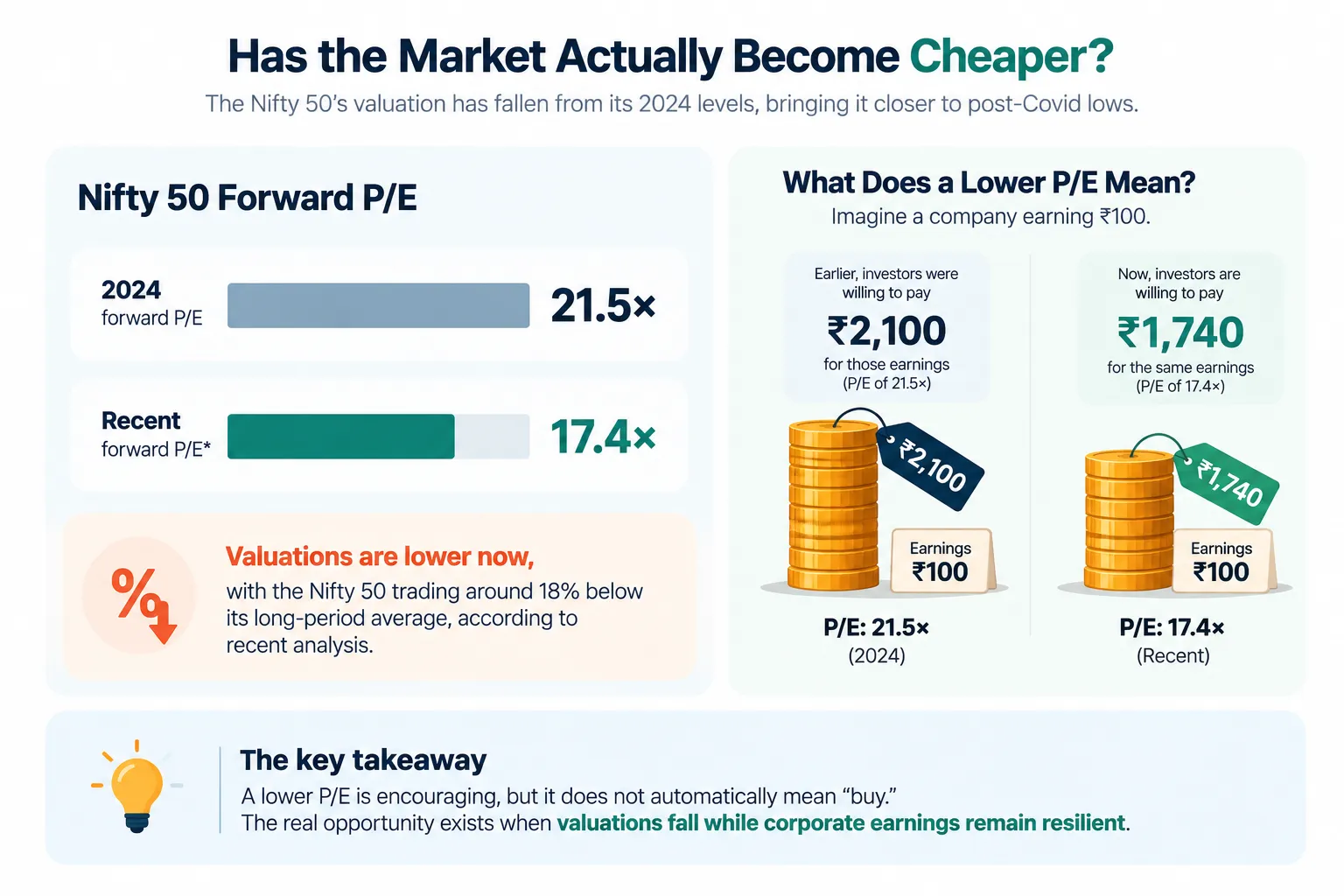
A lower P/E is encouraging, but it does not automatically mean “buy”.
If earnings estimates fall sharply, today's apparently cheap valuation could become expensive again.
The real opportunity exists when valuations fall while earnings remain resilient.
This may ultimately decide whether this is a buying opportunity or simply an early stage of a deeper correction.
Current estimates suggest that Nifty earnings could grow strongly in Q2 FY27. Motilal Oswal expects around 27% year-on-year earnings growth for the Nifty 50, although it also highlights the difficult combination of elevated energy prices, foreign selling and global uncertainty.
This creates the central tension in today's market:
Valuations have become more reasonable, but macroeconomic risks have increased.
If companies continue delivering earnings despite higher crude, interest rates and currency volatility, today's lower valuations could become attractive.
If earnings estimates begin getting downgraded materially, the market may not be as cheap as it appears.
There is no single answer because the appropriate response depends on how the money is being invested.
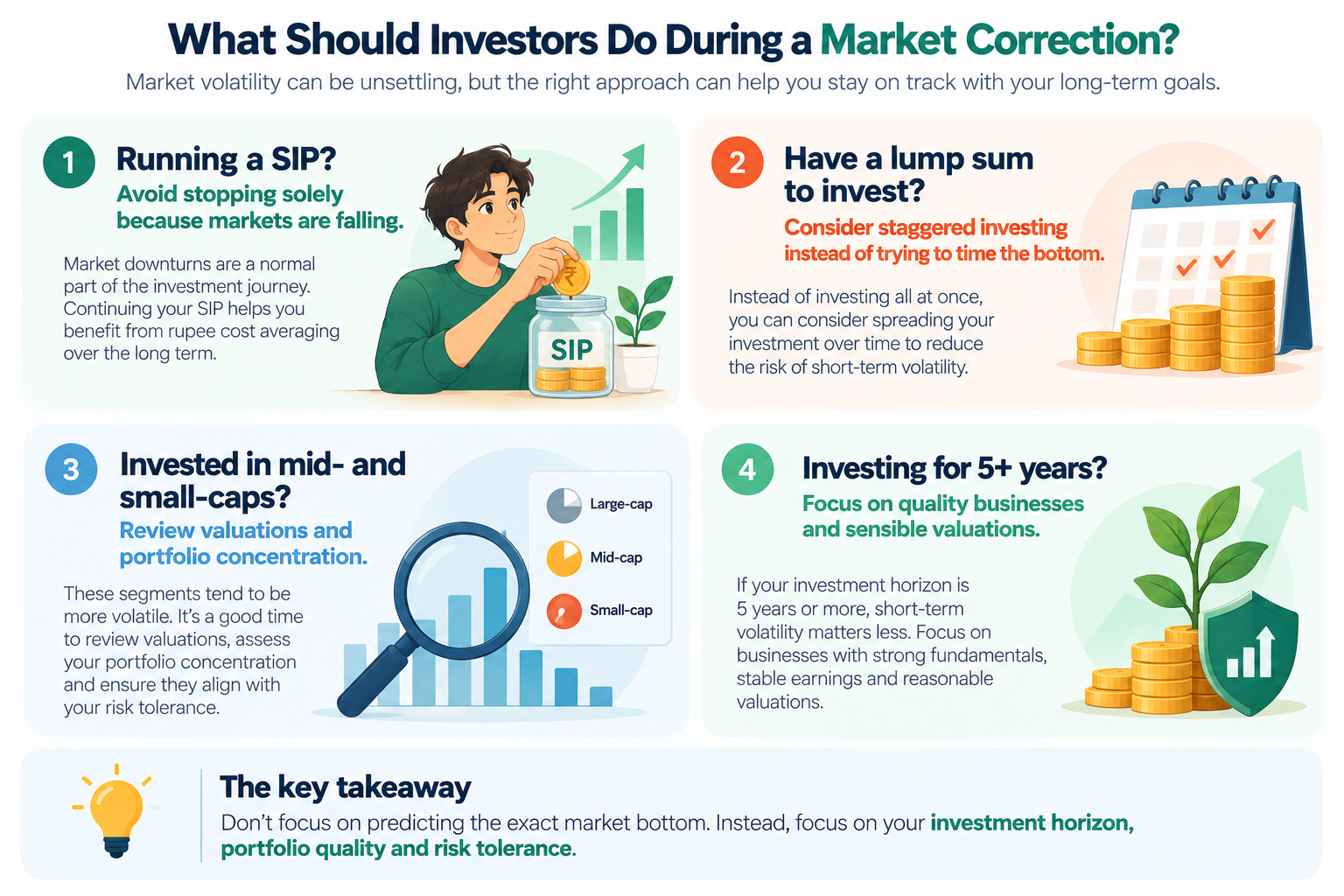
Don't stop simply because the market has fallen.
A SIP automatically buys more units when prices are lower. Trying to pause the SIP and restart it at the “bottom” effectively requires predicting the market twice — when to exit and when to re-enter.
Avoid making the entire investment based on the assumption that the correction is over.
A staggered approach can reduce timing risk. Divide the amount into multiple tranches and deploy them over several months, while reassessing valuations and earnings as new information emerges.
This is a good time to review valuation and portfolio concentration, rather than simply buying more because prices have fallen.
Some mid- and small-cap companies can deliver exceptional long-term growth. But higher valuations and greater earnings uncertainty can also result in larger drawdowns.
Short-term volatility matters less than whether you are buying quality businesses at sensible valuations.
The objective should not be to identify the exact bottom.
It should be to gradually increase exposure when the risk-reward equation becomes more favourable.
Five indicators can provide a useful market dashboard:
1. Crude oil: Does it remain above $100 or begin to cool?
2. The rupee: Does depreciation stabilise?
3. US Treasury yields: Do global yields start falling?
4. FPI flows: Does foreign selling slow?
5. Corporate earnings: Are earnings estimates maintained or downgraded?
If crude stabilises, the rupee finds its footing, global yields ease and corporate earnings remain strong, the current correction could increasingly look like a valuation reset.
If the opposite happens, the market may need more time to find its equilibrium.
The current market environment is neither a simple “buy the dip” opportunity nor a reason to abandon equities.
India's growth story remains strong. But the cost of capital has increased, inflation risks have returned, global yields are high and foreign investors are cautious.
For investors, the most important distinction is therefore between a fall in prices and a deterioration in fundamentals.
A market becomes genuinely attractive when prices fall faster than the underlying earning power of businesses.
That is why, instead of asking “Has the market bottomed?”, investors may be better served asking:
“Are the businesses I own becoming cheaper, or are their future earnings becoming weaker?”
That is the question that will ultimately determine whether this correction becomes an opportunity.
It may be more useful to think in terms of valuation and investment horizon rather than trying to identify the perfect entry point. Investors with long horizons can consider staggered deployment rather than making a single large investment.
Generally, a market correction by itself is not a reason to stop a long-term SIP. Continuing allows the SIP to purchase more units when prices are lower.
Instead of attempting to identify the exact bottom, investors can consider staggered deployment. This reduces the risk of committing the entire amount immediately before another decline.
Stock markets are influenced by more than GDP growth. Inflation, interest rates, crude oil, currency movements, global bond yields, foreign capital flows, valuations and future corporate earnings all influence share prices.
Large caps may deserve greater attention where valuations have become more reasonable and earnings visibility and balance-sheet strength remain strong. However, investors should evaluate individual businesses or funds rather than assuming every large-cap stock is attractive.
Yes. A lower P/E does not guarantee that a stock or index cannot fall further. If expected earnings decline, valuations can remain under pressure even after an initial correction.
Schedule a call based on your convenience. And get an expert to help you invest.
.png)
The financial life game that makes learning fun!
Let's get in touch
Want the best
investment blog delivered straight to your inbox?
Grow your money without wasting time
on stock picking, poring over excel sheets, financial news, analyzing market trends, tracking the Sensex, researching company fundamentals, comparing mutual funds, reading financial reports, trying to predict the future & losing your sanity!